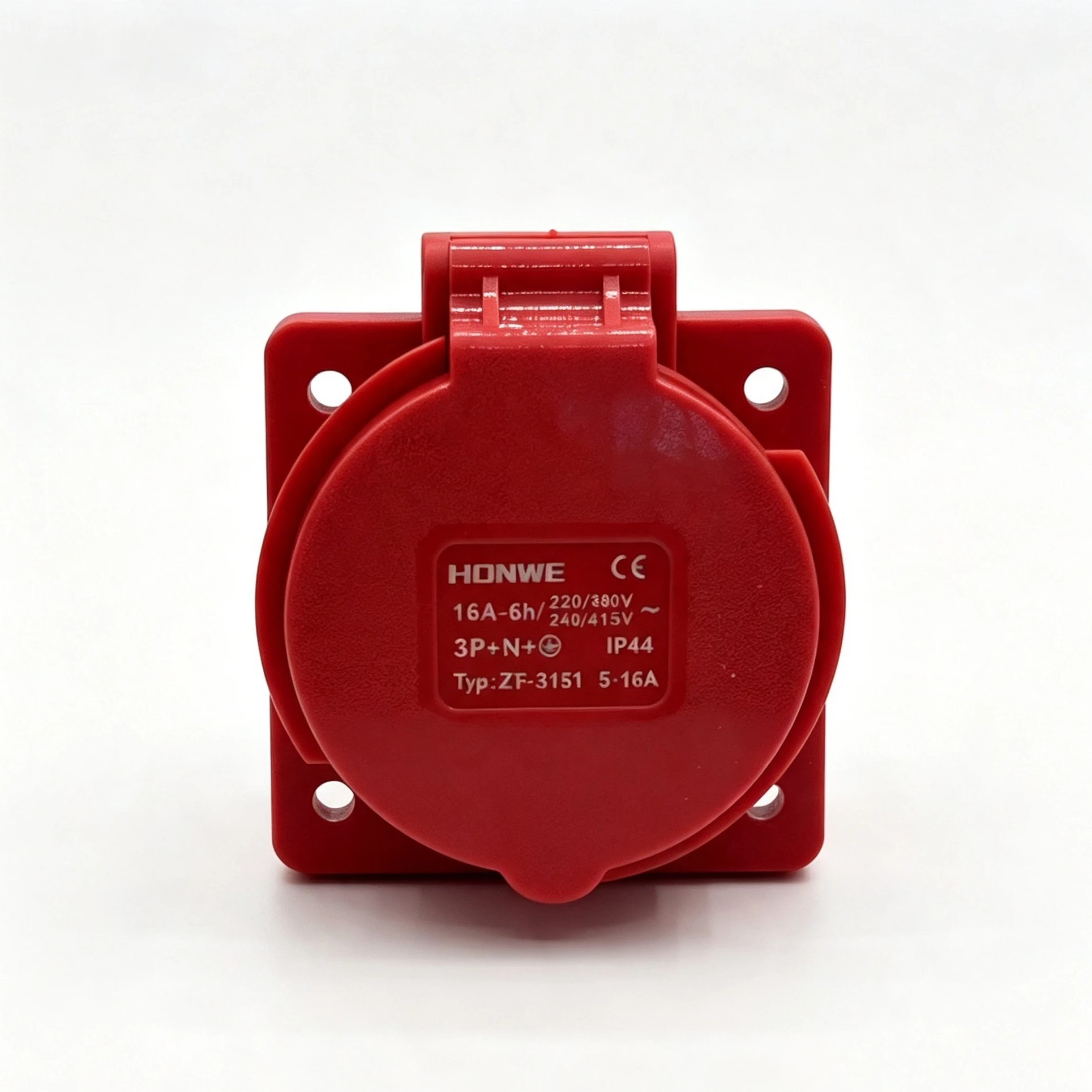
Why are industrial sockets labeled 220/380V~240/415V? This article explains phase voltage, line voltage, and the relationship between two common voltage systems to help you correctly interpret voltage labels on industrial sockets.
What does 220/380V~240/415V mean? How to read voltage labels on industrial sockets?
On industrial plugs, industrial sockets, and generator products220/380V~240/415VVoltage label.
Why does a product list 220V, 380V, 240V, and 415V simultaneously? What do these numbers represent?
To understand this tag, you need to know about three-phase AC power.Phase voltage and line voltage。
1. What is phase voltage?
In a three-phase power supply system,Phase voltage is the voltage between any phase conductor and the neutral (N) line.。
For example:
L1—N ≈ 22 V
L2–N ≈ 220V
L3—N ≈ 22V
Therefore, what we commonly refer to as220VThis is the phase voltage in a typical three-phase system.
In short:
Line ↔ Neutral = Phase Voltage
The 220V phase voltage is primarily used for single-phase electrical equipment, such as lighting, power tools, and small appliances.
2. What is Line Voltage?
Line voltage is the voltage between any two phase conductors in a three-phase power system.
For example:
L1–L2 ≈ 38 V
L2–L3 ≈ 38 V
L1–L3 ≈ 38 V
Therefore, what is commonly referred to as380VThis is the line voltage in a typical three-phase system.
In short:
Line-to-Line = Line Voltage
380V line voltage is primarily used for three-phase motors, industrial machinery, and other three-phase equipment.
III. Why does 220V become 380V?
In a balanced three-phase AC system, the line voltage is approximately √3 times the phase voltage:
Line voltage = Phase voltage × √3
For example:
220V × 1.732 ≈ 380V
Therefore, within the same three-phase power system, both of the following can coexist:
220V phase voltage
and
380V line voltage
This is why you often see "220/380V" in industrial electrical systems.
4. What does "240/415V" mean?
In addition to 220/380V, some countries and regions also use240/415VThis nominal voltage system.
where:
240V = Phase Voltage
415V = Line Voltage
Both exhibit a ratio of approximately √3:
240V × 1.732 ≈ 415V
Therefore:
220/380Vand240/415V
Both fundamentally denote phase and line voltages in a three-phase AC system, differing only in the grid voltage standards they correspond to.
5. Why are industrial sockets labeled with 220/380V~240/415V?
If an industrial plug or socket is marked:
220/380V~240/415V
Typically indicates that the product is suitable for the corresponding range of AC three-phase power supply systems.
The "/" here can be interpreted as:
Phase Voltage / Line Voltage
For example:
220/380V
Typically:
Approximately 22V between the live and neutral wires
Approximately 380V between two phase lines
and:
240/415V
indicates:
Approximately 24V between the live and neutral wires
Approximately 415V between two phase lines
Note that this does not mean the outlet can switch arbitrarily between 220V, 380V, 240V, and 415V; rather, it refers to the voltage system indicated by the product's rated voltage label.
What does the "~" symbol mean?
The "~" symbol after the voltage, represented as **~**, indicates alternating current (AC).
For example:
220/380V~
Indicates that the product is suitable for the corresponding AC voltage system.
When inspecting industrial plugs, sockets, or generator nameplates, check not only the voltage values but also the electrical symbols and complete product specifications.
7. How do industrial sockets correspond to 220V and 380V?
Different devices require different power supply methods, so industrial sockets vary in the number of pins.
220V Single-Phase Device
Common configurations include:
L + N + PE
Live, neutral, and protective earth, corresponding to the common 3-pin industrial socket.
38V Three-Phase Equipment
If the device does not require a neutral wire, common configurations include:
L1 + L2 + L3 + PE
Matches a 4-pin industrial socket.
If the three-phase equipment also requires a neutral conductor, the common configuration is:
L1 + L2 + L3 + N + PE
Matches a 5-pin industrial socket.
Therefore,Three-phase does not necessarily require a 5-pin socket.Choose between 4-core or 5-core based on whether the device requires a neutral wire.
8. What else should you consider when choosing an industrial socket?
When selecting industrial plugs and sockets, don't just look at 220V or 380V. You also need to confirm:
Rated Current: e.g., 16A, 32A, 63A
Rated Voltage: such as 220V, 380V, etc.
Number of Cores/Poles: 3-core, 4-core, 5-core, etc.
Clock bit: Ensure correct matching across different specifications
Protection Rating: such as IP44, IP67
Usage Environment: Indoor, outdoor, construction sites, or damp environments
For example, although both are 32A industrial sockets, the structure and wiring methods for 220V single-phase and 380V three-phase products may differ; do not assume compatibility based solely on rated current.
Summary
on the industrial socket220/380V~240/415V, mainly refers to two types of voltages in a three-phase AC system:
Voltage between phase and neutral = Phase voltage
Line-to-line voltage = Line voltage
220/380V and 240/415V correspond to different nominal voltage systems. When selecting industrial plugs and sockets, considerVoltage, Rated Current, Number of Cores, Clock Bit, Protection Classmatch against all parameters, not just a single number.
Wenzhou Keben Electrical Appliance FactoryWe offer industrial sockets in various specifications. Contact us for inquiries and purchases.