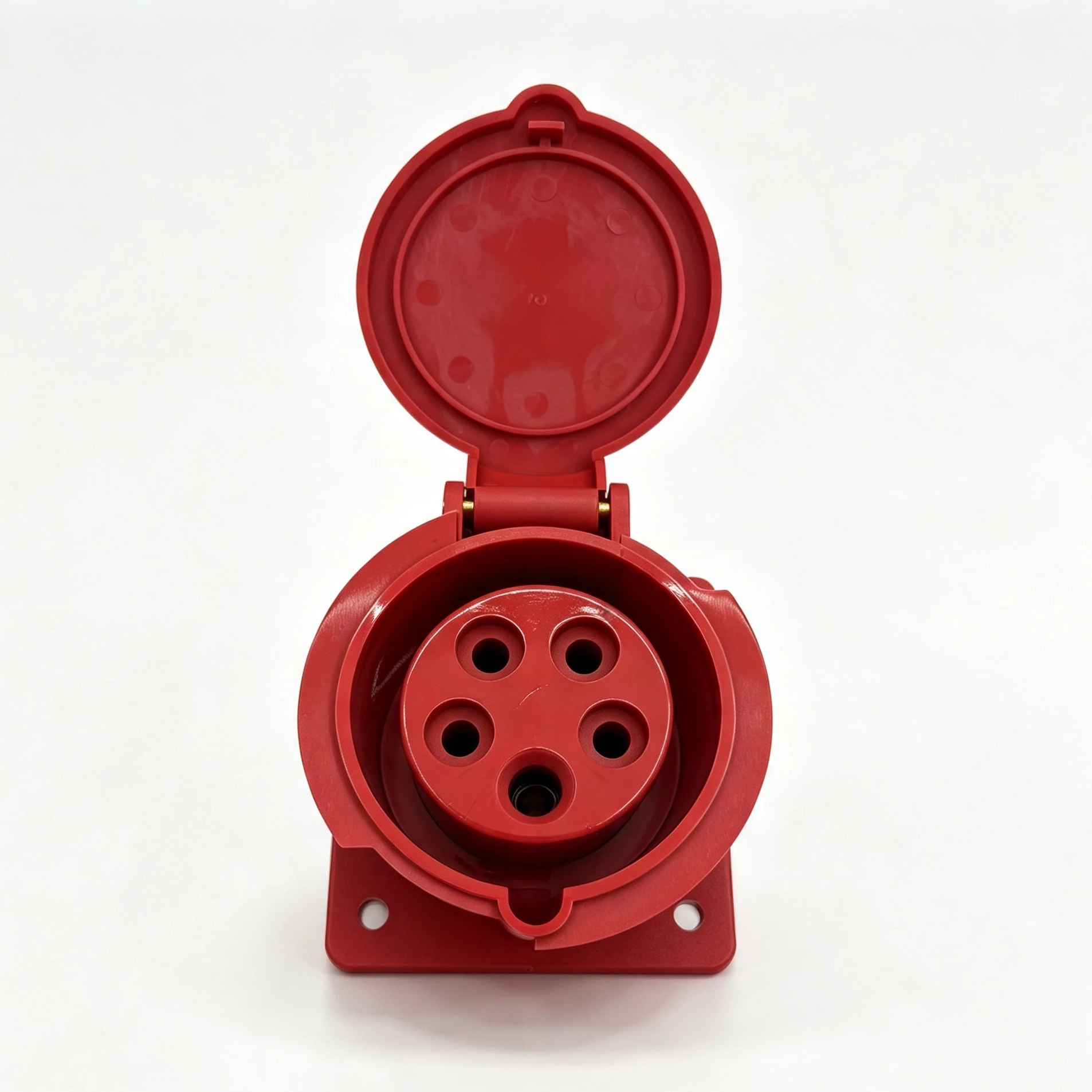
Industrial socket selection requires considering rated current, voltage, number of poles, IP rating, and operating environment. This guide provides detailed criteria to help you quickly find the right industrial socket product.
What is an industrial socket? What types of industrial sockets are available?
In factories, construction sites, heavy machinery operations, mines, warehouses, and outdoor projects, electrical equipment often requires more reliable power connections. **Industrial Sockets** are specifically designed for connecting power to industrial and professional electrical equipment.
Unlike standard household outlets, industrial sockets feature a more robust design and are available in various configurations to suit different equipment and operating environments.Rated Current, Rated Voltage, Number of Poles, Mounting Method, and IP Protection Rating。
So, what is an industrial socket? What types are available? What's the difference between 16A and 32A industrial sockets? How do you choose between IP44 and IP67?
This article covers the definition, classification, specifications, and selection of industrial power outlets.
1. What is an industrial socket?
An industrial socket is a power connection device primarily used for industrial equipment, machinery, and professional electrical systems, typically requiring matchingIndustrial PlugUse together.
Industrial sockets provide a reliable electrical connection between equipment and power sources, enabling easy plug-in and disconnect operations.
Common industrial sockets are used for:
Factory Production Equipment
Industrial Machinery
Construction Equipment
Mining Equipment
Agricultural Machinery
Power generation equipment
Warehousing and Logistics Equipment
Outdoor Engineering Equipment
Temporary Power Distribution System
Industrial sockets are not a single-specification product; they form multiple product series based on different electrical parameters and installation environments.
2. What types of industrial sockets are there?
Industrial sockets can be classified according to different standards.
Common classification methods include:
Categorized by installation method
Sort by extreme value
Categorized by rated current
Categorized by IP Rating
Different classification methods highlight different product features; in practice, selecting the right option usually requires evaluating multiple parameters simultaneously.
3. Classified by Installation Method
One of the most common ways to classify industrial sockets is by installation method.
1. Wall-mounted industrial socket
Wall-mounted industrial sockets are typically fixed to walls, equipment brackets, or other permanent locations.
Ideal for factory floors, warehouses, production areas, and other locations requiring fixed power outlets.
Features stable installation, ease of use, and compatibility with fixed power distribution lines.
2. Panel-mounted industrial socket
Panel-mounted industrial sockets are typically installed on control cabinets, distribution boxes, machinery enclosures, or equipment panels.
This structure enables direct integration of industrial power connectors into devices, commonly used for:
Industrial Control Cabinet
Automated Equipment
Distribution box
Machinery
Electrical Control System
When selecting a panel-mount industrial socket, verify both the cutout dimensions and the equipment panel structure.
3. Flush-mount industrial socket
Flush-mount industrial sockets are typically installed within walls, junction boxes, or other structures.
Compared to surface-mounted designs, recessed structures reduce the protrusion of the socket body at the installation point, making them ideal for fixed installations in industrial and commercial settings.
4. Mobile Industrial Socket
Mobile industrial sockets are typically used with cables and can be relocated to different positions as needed.
Common applications include:
Construction site
Temporary Construction
Outdoor Work
Device Repair
Temporary Power Distribution
For work scenarios requiring frequent power relocation, mobile industrial outlets offer greater convenience.
IV. Classified by Pole Count
Industrial sockets can also be classified by the number of electrical poles.
Common configurations include:
2P+E Industrial Socket
2P+E denotes two power poles and one grounding pole, suitable for single-phase power supply systems.
3P+E Industrial Socket
3P+E denotes three power poles and one grounding pole, commonly used in corresponding three-phase power systems.
3P+N+E Industrial Power Outlet
3P+N+E represents three-phase, neutral, and ground connections, suitable for devices requiring all three.
Please note thatIndustrial sockets come in various pole configurations; not all are three-phase, four-pin types.。
The specific configuration depends on the device's power supply method and electrical system.
5. Classified by Rated Current
Rated current is a critical parameter for industrial sockets.
Common industrial socket rated current specifications include:
16A Industrial Socket
32A Industrial Socket
63A Industrial Socket
12 5A Industrial Socket
Industrial sockets with different rated currents are designed for various devices and electrical systems.
For example, 16A industrial sockets are typically used for equipment matching their current rating, while 32A industrial sockets can support devices with higher current requirements.
When selecting the rated current, avoid assuming "the higher the better." Instead, match it to the equipment's rated current, rated power, and power supply system.
Additionally, the rated current of industrial plugs and sockets must be matched.
6. Classified by IP Protection Rating
Industrial equipment operates in diverse environments, so industrial sockets are typically offered with varying levels of protection.
IP RatingIndicates the degree of protection of electrical equipment enclosures against solid foreign objects and water.
Common ingress protection ratings for industrial sockets include IP44, IP54, and IP67.
IP44 Industrial Socket
IP44 industrial sockets offer protection against solid objects and splashing water, meeting the requirements of certain general industrial environments.
IP54 Industrial Socket
IP54 industrial sockets offer superior dust and water resistance, making them suitable for industrial environments with moderate dust and moisture.
IP67 Industrial Socket
IP67 industrial sockets offer superior dust and water protection for demanding industrial and outdoor environments.
Select the appropriate protection rating based on the installation location and on-site environment.
7. Industrial sockets can also be selected based on voltage.
In addition to the rated current,Rated VoltageAlso an important parameter for industrial sockets.
Industrial outlets are available with rated voltage specifications tailored to various electrical systems.
When selecting an industrial socket, first confirm:
Rated Voltage
Power System Voltage
Rated current of the device
Power Frequency
Extremum
Industrial sockets are compatible with corresponding devices only when these parameters match.
Therefore, when purchasing industrial sockets, do not select products based solely on "16A" or "32A"; verify the complete electrical specifications.
8. Industrial sockets must be paired with industrial plugs.
Industrial sockets are typically used with industrial plugs.
A complete industrial power connection system typically includes:
Power → Industrial Socket → Industrial Plug → Cable → Industrial Equipment
Industrial plugs and sockets must match across multiple parameters, including:
Rated Voltage
Rated Current
Extremum
Interface Structure
Protection Rating
Related Standards
For example, a 32A industrial socket typically requires a matching 32A industrial plug.
Therefore, when selecting an industrial socket, also verify the specifications of the matching industrial plug.
To learn more about industrial plugs, read:
9. What standard do industrial sockets follow?
Industrial plugs and sockets commonly used in the international market typically adoptIEC 60309Series standards.
IEC 60309 standardizes plugs, sockets, and connectors for industrial use, specifying rated current, rated voltage, number of poles, and interface structures.
For export products, you must also verify the applicable product standards, certifications, and regulatory requirements in the target market.
Therefore, if industrial sockets are intended for export or specific industrial projects, it is recommended to verify the requirements of the target country or region before purchasing.
10. How to Choose the Right Industrial Socket?
To select the right industrial socket for different types, follow these steps.
1. Confirm rated voltage
First, verify the rated voltage of the equipment and power system.
2. Confirm rated current
Select the appropriate rating—1 6A, 3 2A, 6 3A, or 12 5A—based on the device's actual operating current.
3. Confirm pole count
Select configurations such as 2P+E, 3P+E, or 3P+N+E based on the device's power supply method.
4. Confirm IP protection rating
Select the appropriate protection rating based on the installation environment.
For standard indoor environments, select the appropriate specifications based on your actual needs.
For outdoor use, construction sites, damp environments, or dusty areas, prioritize the product's dust and water resistance.
5. Confirm Installation Method
Select based on installation location:
Wall-mounted
Panel-style
Recessed
Portable
6. Confirm compatible industrial plug
Finally, confirm that the voltage, current, number of poles, and interface structure of the industrial plug and socket are compatible.
11. Which industries are industrial sockets suitable for?
Industrial sockets come in various specifications and mounting styles, making them suitable for a wide range of applications.
Common industries include:
Manufacturing: production lines, industrial machinery, automation equipment.
Construction IndustryConstruction equipment, portable tools, temporary power distribution.
Energy Industry: Power generation equipment, energy facilities, and related industrial machinery.
MiningMining machinery and industrial equipment.
Logistics IndustryWarehousing equipment, logistics machinery, and industrial electrical equipment.
AgricultureAgricultural machinery, pumping stations, and other agricultural electrical equipment.
Outdoor EngineeringOutdoor machinery, temporary power supplies, and construction equipment.
Select industrial socket specifications based on equipment parameters and environmental conditions for different application scenarios.
XII. Summary
Industrial sockets are products used to connect power for industrial equipment and professional electrical devices.
Industrial sockets can be categorized intoWall-mounted, panel-mounted, recessed, and mobile; Based on the number of poles, it can be classified into2P+E, 3P+E, 3P+N+Efor different configurations; based on the rated current, you can choose16A、32A、63A、125AAvailable in various specifications; industrial sockets with different IP protection ratings can be selected based on the operating environment.
Therefore, when selecting an industrial socket, you need to consider the following comprehensively:
Rated Voltage + Rated Current + Poles + IP Rating + Mounting Method + Operating Environment + Matching Industrial Plug
No single industrial socket fits all equipment and environments. To ensure a stable, reliable power connection, select products that match your specific electrical parameters and installation requirements.
Wenzhou Keben Electrical Appliance FactoryWe offer industrial sockets in various specifications. Contact us for inquiries and purchases.