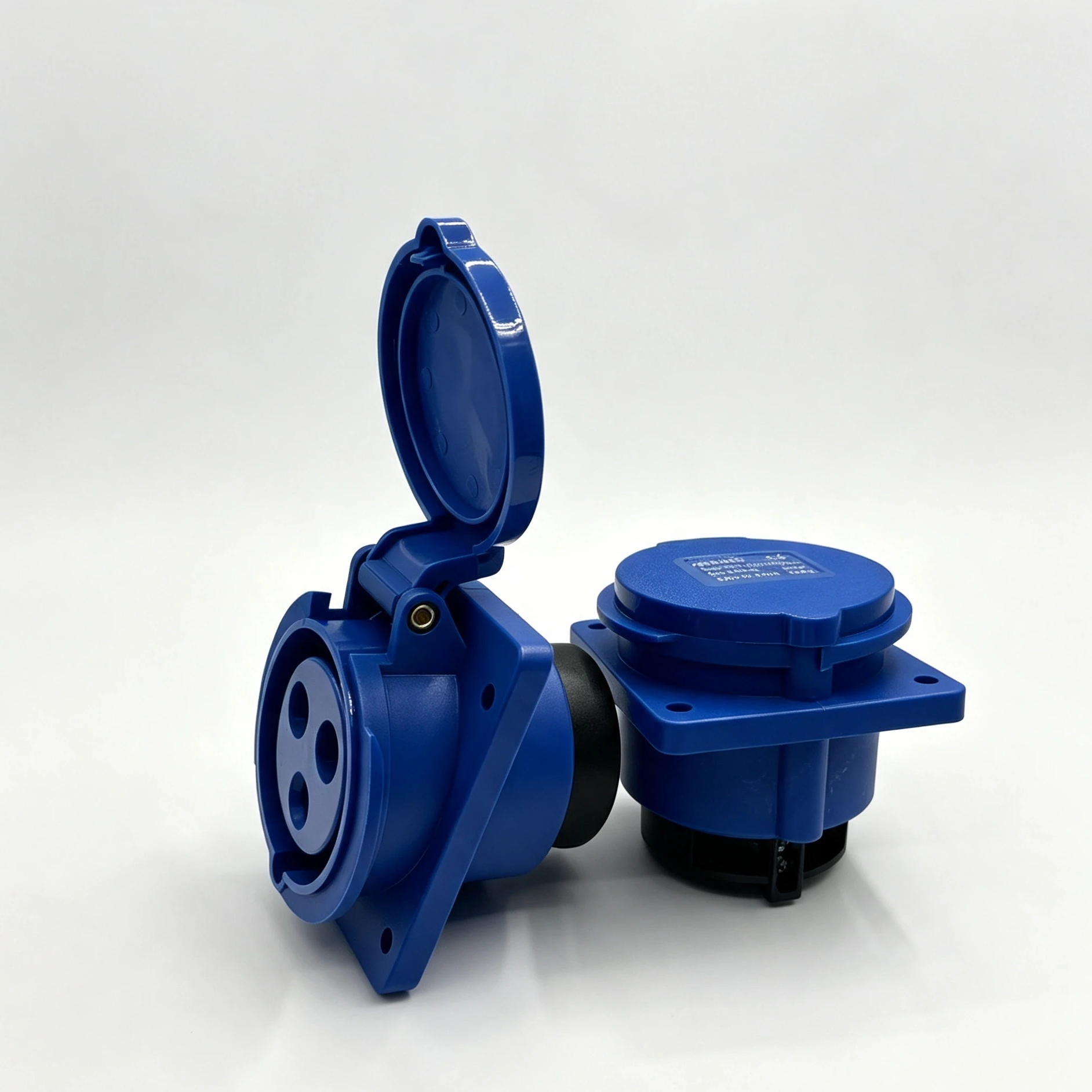
Industrial sockets differ significantly from standard household outlets in operating environment, structural design, rated current and voltage, and protection ratings. This article covers the features, types, and selection methods for industrial sockets across multiple dimensions.
What's the difference between industrial and standard outlets? Learn about the features and applications of industrial sockets in one article.
In factories, construction sites, mines, industrial machinery, and outdoor engineering projects, we often encounter a product that looks distinctly different from standard household outlets—Industrial Socket。
Industrial sockets are primarily used for power connections in industrial equipment, machinery, and temporary distribution systems. Compared to standard household and office outlets, industrial sockets offerStructural design, rated current, rated voltage, protection class, mechanical strength, and operating environmentdiffer significantly in many aspects.
So,What is the difference between industrial and standard sockets? What types of industrial sockets exist? How do 16A and 32A industrial sockets differ?
We will cover the following aspects.
1. What is an industrial socket?
An industrial socket is a power outlet designed specifically for connecting industrial and commercial electrical equipment, typically used in conjunction with industrial plugs.
Compared to standard household outlets, industrial outlets must withstand more demanding environments. They typically feature rugged designs and mechanically robust materials, with varying protection ratings and electrical specifications tailored to specific applications.
Common industrial sockets can be used for:
Factory and production workshop
Construction site
Mine
Oil and Energy Industry
Machinery
Agricultural Equipment
Warehousing and Logistics Facilities
Power generation equipment
Outdoor Engineering
Temporary Power Distribution System
Industrial sockets are typically paired with industrial plugs to form a complete industrial power connection system.
2. What is the difference between an industrial socket and a standard socket?
The most obvious difference between industrial sockets and standard household outlets lies in theirDesigned for different applications and operating environments。
Standard outlets are used in homes, offices, and stores to power common appliances such as TVs, refrigerators, computers, phone chargers, and air conditioners.
Industrial sockets are primarily used for industrial and professional electrical equipment, ensuring stable and safe electrical connections in more demanding environments.
The key differences between the two include the following aspects.
1. Different usage environments
Standard outlets are typically installed in stable indoor environments with minimal exposure to mechanical shock, dust, moisture, and other environmental factors during use.
Industrial sockets may be installed in factories, construction sites, mines, or outdoor environments, requiring resistance to dust, moisture, rain, mechanical impact, vibration, and frequent plug-in/out cycles.
Therefore, industrial sockets typically require enhanced environmental adaptability.
2. Different structural design
Standard household outlets are designed primarily for convenience in daily power use, with a relatively simple structure.
Industrial sockets prioritize mechanical strength and connection reliability. Many feature reinforced housings, locking mechanisms, protective covers, and cable retention systems to minimize the risk of loosening caused by vibration, pulling, or impact during operation.
Some industrial sockets feature anti-misinsertion designs to prevent mixing products with different rated voltages and specifications.
3. Rated current and voltage specifications differ
Standard household outlet specifications are designed to meet the power needs of residential appliances.
Industrial sockets offer a wider range of rated current and voltage specifications. Common rated currents for industrial applications include:
16A Industrial Socket
32A Industrial Socket
63A Industrial Socket
12 5A Industrial Socket
Select industrial socket specifications based on actual rated power, voltage, and operating current for different devices.
Therefore, when selecting an industrial outlet, don't just look at its appearance; also verify the actual electrical parameters of the equipment.
3. What are the common types of industrial sockets?
Industrial sockets are not a single product type; they come in various configurations depending on installation method, number of poles, and application environment.
1. Wall-mounted industrial socket
Wall-mounted industrial sockets are typically fixed to walls, equipment enclosures, or distribution panels and are designed for permanent installations in factories, workshops, warehouses, and similar facilities.
This installation method reduces cable strain caused by movement and simplifies power connections for industrial equipment.
2. Panel-mounted industrial socket
Panel-mounted industrial sockets are installed on control cabinets, distribution boxes, machinery panels, or other electrical equipment.
For applications requiring industrial power connectors to be directly integrated into equipment, panel-mount industrial sockets are a common choice.
3. Flush-mount industrial socket
Recessed industrial sockets are installed within walls or mounting boxes, ideal for applications requiring fixed installation with minimal external protrusion.
4. Mobile Industrial Socket
Portable industrial sockets are designed for use with cables and can be relocated as needed. They are commonly used in construction sites, temporary work zones, electrical maintenance, and outdoor operations.
4. What does the number of poles mean for an industrial socket?
When selecting industrial power outlets, you will often encounter2P+E, 3P+E, 3P+N+EEqual sign.
These markings indicate the number of electrical poles inside industrial sockets.
For example:
2P+E+: Two poles with ground
3P+E: Three-pole plus ground
3P+N+EThree-phase, neutral, and ground
The specific choice depends on the device's power supply system.
Therefore, not all industrial sockets are "three-phase four-pin." Industrial sockets come in various pole counts and configurations; different equipment requires matching products.
V. What are the IP protection ratings for industrial sockets?
Industrial equipment often operates in humid, dusty, or outdoor environments, soIP RatingThis is also a critical parameter when selecting industrial sockets.
Common IP ratings for industrial sockets includeIP44, IP54, IP67etc.
For example:
IP44 Industrial SocketSuitable for work environments requiring dust and splash water resistance.
IP67 Industrial SocketHigher dust and water resistance for demanding industrial and outdoor environments.
Note that the IP rating reflects the overall protection level of the product. In actual use, you must also consider the installation method, plug compatibility, and specific operating environment.
6. What is the difference between the 1 6A industrial socket and the 3 2A industrial socket?
16A and 32A are common rated current specifications for industrial sockets.
In short:
16A Industrial SocketFor equipment rated at currents not exceeding its design capacity.
32A Industrial SocketFor devices requiring higher current capacity.
However, this does not mean that 32A sockets can arbitrarily replace 16A sockets.
Selecting an industrial outlet requires considering:
Rated Voltage
Rated Current
Extremum
Frequency
Protection Rating
Installation Method
Plug Specifications
Actual Device Power
Only when these parameters match can a reliable industrial power connection be established.
7. Industrial sockets must be used with matching industrial plugs.
Industrial sockets are typically not used alone but paired with ** industrial plugs ** to form a complete power connection system.
Industrial plugs and industrial sockets must match in the following aspects:
Rated Voltage + Rated Current + Poles + Interface Structure + Protection Rating + Relevant Standards
For example, a 32A industrial socket typically requires a matching 32A industrial plug.
Do not assume products are safe to use just because they look similar or a plug fits into a socket.
Incorrect specification matching can lead to poor contact, abnormal heating, equipment failure, or electrical safety hazards.
8. What standards are typically used for industrial sockets?
Industrial plugs and sockets commonly used in the international market typically featureIEC 60309Series standards.
IEC 60309 standardizes plugs, sockets, and connectors for industrial use, covering rated voltage, rated current, number of poles, and mechanical construction.
For export-oriented industrial electrical products, understanding the relevant standards applicable to target markets is crucial.
Different regions may have additional local standards or certification requirements. When purchasing industrial sockets, verify the applicable standards and certifications based on the target market.
9. Why Are Industrial Outlets More Durable Than Standard Outlets?
Industrial sockets are designed to withstand harsher environments, with targeted improvements in materials and structure.
For instance, some industrial power outlets use engineering plastics with high mechanical strength and impact resistance. Thicker housings, sealed structures, and cable retention systems further enhance overall product reliability.
For industrial sockets used outdoors, at construction sites, or in damp environments, consider products with higher IP ratings.
Therefore, the durability of an industrial socket depends not only on the housing material but also on its structural design, contact components, cable connection method, and overall protection scheme.
10. Can industrial sockets replace standard household outlets?
Industrial and standard household sockets cannot be used interchangeably.
The two products are designed for different environments and requirements.
If the device is designed for industrial plugs and sockets, use compatible industrial power connection products. Do not substitute by modifying standard household outlets.
Similarly, ordinary household appliances do not necessarily require industrial outlets. Whether to use an industrial outlet should be determined based on the device's electrical specifications, installation environment, and actual usage requirements.
How to Choose an Industrial Socket?
When selecting an industrial socket, follow these steps:
First, verify the rated voltage.
Ensure the industrial socket's rated voltage matches the equipment's power supply system.
Second, confirm the rated current.
Select the appropriate specification, such as 1 6A, 3 2A, 6 3A, or 12 5A, based on the device's operating current.
Third, confirm the number of poles.
Select the appropriate configuration, such as 2P+E, 3P+E, or 3P+N+E, based on your single-phase or three-phase power supply system.
Fourth, verify the protection rating.
Select an appropriate IP protection rating based on the operating environment, such as IP44 or IP67.
5. Confirm the installation method.
Select wall-mounted, panel, flush, or mobile industrial sockets based on equipment and installation location.
Six, confirm the matching industrial plug.
Industrial sockets must be used with matching industrial plugs of the corresponding specification.
Summary of Differences Between Industrial and Standard Outlets
Generally, standard sockets serve residential and general commercial power needs, while industrial sockets are designed for industrial equipment and more complex environments.
Industrial sockets typically feature a more robust construction, a wider range of electrical specifications, and enhanced environmental adaptability. They are available in various rated current options—including 1 6A, 3 2A, 6 3A, and 12 5A—along with different pole counts and IP protection ratings to suit diverse application requirements.
If you need to select an industrial socket, don't just focus on appearance—consider all factors.Rated Voltage, Rated Current, Poles, Protection Class, Mounting Method, and Operating Environment。
Industrial sockets must be used with matching industrial plugs. A secure and reliable power connection is only possible when the plug and socket specifications are compatible.
If you are looking for solutions suitable for factories, industrial machinery, construction sites, or outdoor environmentsIndustrial plugs and industrial socketsSelect the rated current, number of poles, mounting type, and IP protection rating based on actual application requirements.
Wenzhou Keben Electrical Appliance FactoryWe offer industrial sockets in various specifications. Contact us for inquiries and purchases.