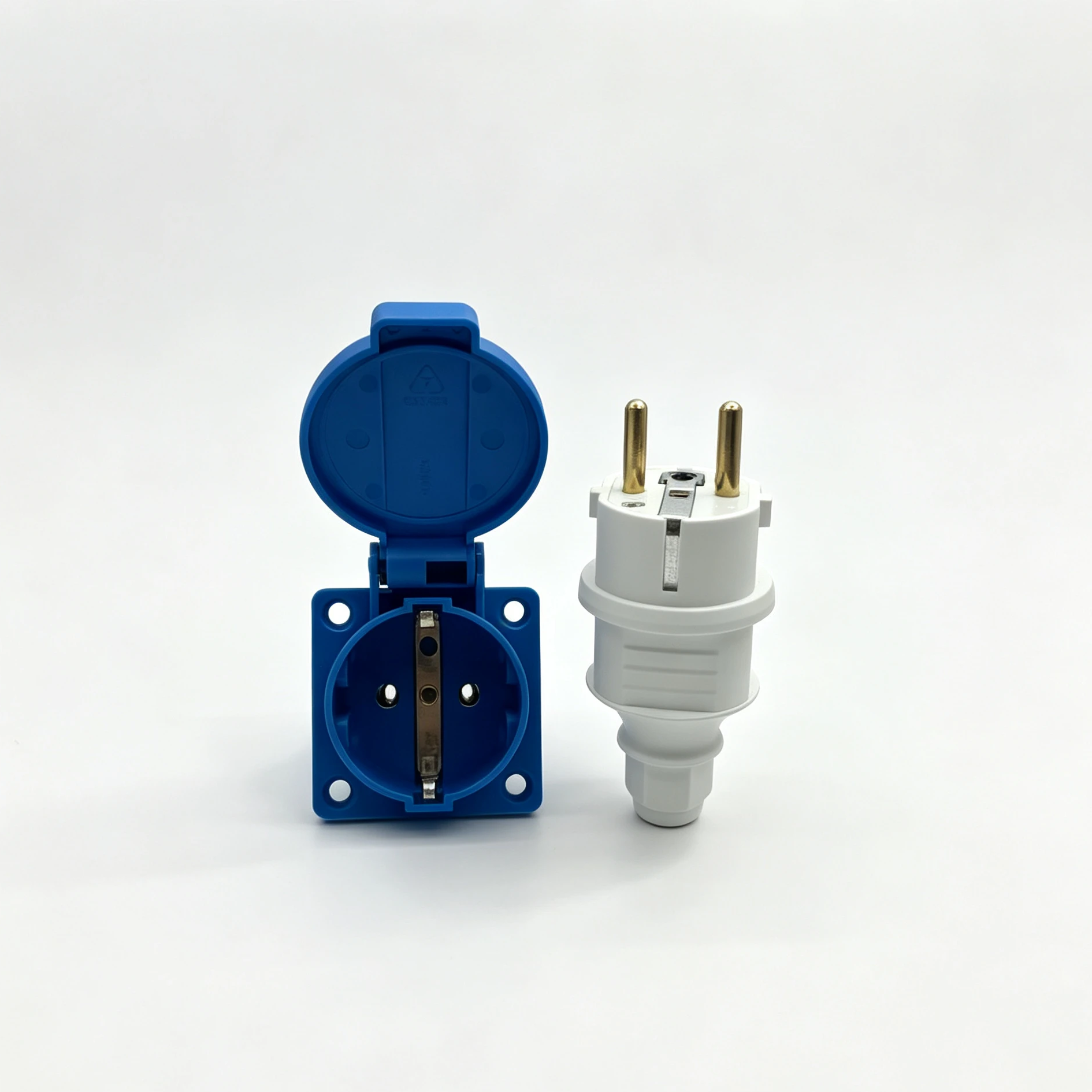
Generator industrial sockets should be selected based on output voltage, rated current, number of poles, and operating environment. This article covers the 6A, 2A, and 3A industrial socket models (1, 3, 6) and their applicable scenarios across different protection ratings.
What industrial outlet should be used for a generator? How to select a generator industrial outlet?
Generators are common backup and mobile power sources widely used in construction sites, factories, outdoor operations, agriculture, and emergency power supply scenarios.
When the generator is operating, it must safely and stably deliver generated power to connected loads. Therefore, the power connection interface is critical. Compared with standard residential outlets,Industrial plugs and industrial socketsTypically better suited for power connections of industrial equipment such as generators.
Which industrial socket should be used for the generator? What parameters need to be considered when selecting a generator socket?
1. Why are generators typically equipped with industrial-style outlets?
Generator operating environments are typically more complex than standard household conditions.
For example, construction sites may involve dust, rainwater, and sand; outdoor operations face moisture, impacts, and frequent movement; industrial settings often require long-term connections to high-power equipment.
Industrial plugs and sockets feature more robust mechanical construction and offer selectable protection ratings for various operating environments, making them better suited for power connections to equipment such as generators.
For generators intended for long-term use or frequent relocation, industrial-grade outlets enhance the reliability of power connections.
2. What key parameters should you look for in a generator outlet?
When selecting an industrial generator outlet, don't just look at the amperage. You need to consider several other parameters:
Rated current, rated voltage, number of poles, protection class, and mounting method.
Rated current and number of poles are particularly important.
III. How to choose the 16A, 32A, and 63A generator sockets?
Common rated currents for industrial generator sockets include:
16A, 32A, 63A, etc.
Rated current does not indicate the generator's actual output, but rather the maximum current that the socket and its associated connection system can safely handle.
Generally:
16A Industrial Socket
Suitable for low-power electrical devices and small generator applications.
Commonly found in:
Small Construction Equipment
Power tools
Mobile Devices
Temporary Power Supply
32A Industrial Socket
32A industrial sockets are one of the most common specifications used in industrial settings.
Suitable for:
generator
Construction Equipment
Industrial Machinery
Portable Power Bank
Temporary Power Distribution System
If the generator needs to power multiple industrial devices, 32A is also a common choice.
63A Industrial Socket
63A is typically used for industrial equipment and power distribution systems with higher current requirements.
For example:
Large Generators
High-power industrial equipment
Construction Machinery
Temporary power distribution equipment
The specific selection must be calculated based on the generator's rated output and actual load.
Do not select a higher-current socket just because the generator has high power.
The rated parameters of the outlet, cable, plug, circuit breaker, and generator output must all match.
4. How many pins should a generator outlet have?
Common pole configurations for industrial plugs and sockets include:
3-core, 4-core, and 5-core.
The specific choice depends on the generator's output method and the connected device's electrical system.
For example:
Single-phase power
Common configurations include:
L + N + PE
These are the live wire, neutral wire, and protective earth.
Three-phase power
Common configurations include:
3P + PE
Or:
3P + N + PE
where:
L1/L2/L3: Three-phase power
N: Neutral
PE: Protective Earth
Therefore, the number of cores in the industrial socket used for a generator cannot be determined solely by its power rating; it must be based onGenerator Output Power Type and Equipment Connection RequirementsOK.
5. Do generator outlets need to be waterproof?
If the generator is used outdoors or on construction sites, the IP rating is also a critical parameter.
Common protection ratings for industrial sockets include:
IP44, IP54, IP67, etc.
IP44 Industrial Socket
Provides limited protection against solid objects and water splashes; suitable for certain general industrial environments.
IP67 Industrial Socket
Higher dust and water resistance for demanding outdoor and humid environments.
If the generator is used outdoors for extended periods, especially in environments with heavy rain or sand and dust, consider selecting industrial sockets with a higher IP rating based on actual conditions.
Note:
IP ratings are just one indicator of a product's protection capabilities and should not be assumed to mean that "IP67" is suitable for all outdoor environments.
Actual usage also depends on the product's installation method, connection status, and on-site environment.
6. What material should be used for generator industrial sockets?
For long-term use, generator sockets must withstand repeated plugging/unplugging, impacts, temperature fluctuations, and harsh environments. Therefore, the materials used for the housing and internal structure are critical.
Common plastic materials for industrial sockets include:
PC
ABS
PA (Nylon)
Different materials have different characteristics.
PCOffers excellent impact resistance and heat resistance;
ABSOffers excellent overall mechanical and machinability properties;
PA NylonThis results in high mechanical strength, wear resistance, and fatigue durability.
Specific materials should be selected based on the product structure, operating environment, and performance requirements.
7. Should the generator socket be 16A or 32A?
This is a common issue in the procurement process.
Do not simply select a larger outlet based on the generator's power rating.
The right approach is to consider:
Generator Rated Output → Operating Current → Load Type → Cable Specification → Plug and Socket Rated Current → Protective Device
For example, if a generator needs to connect to 32A industrial equipment, the plug, socket, cable, and protective devices must all meet the corresponding current requirements.
If the device's actual current draw exceeds the outlet's rated capacity, upgrading to a higher-rated outlet is not a solution; the entire power supply system design must be re-evaluated.
8. How to choose a generator outlet?
If selecting an industrial outlet for a generator, follow these steps:
Step 1: Verify generator output voltage
Confirm whether it is single-phase or three-phase, and specify the rated voltage.
Step 2: Confirm rated current
Select specifications such as 16A, 32A, or 63A based on generator output and actual load.
Step 3: Confirm pole count
Select the 3-pin, 4-pin, or 5-pin connector based on the power system.
Step 4: Confirm Protection Level
For indoor use, select the appropriate protection level based on the environment. For outdoor or humid environments, prioritize waterproof and dustproof capabilities.
Step 5: Confirm plug and socket compatibility
Industrial plugs and industrial sockets are required forCurrent, Voltage, Number of Poles, Construction, and Related Specificationsmatch each other.
Do not assume safe compatibility just because a plug "fits."
9. Common Industrial Generator Socket Applications
Generator industrial sockets are suitable for various scenarios requiring mobile or backup power, such as:
Construction site
Provides power for power tools, construction equipment, and temporary distribution systems.
Factory
Connection interface for backup power systems or mobile power equipment.
Outdoor Work
For outdoor construction, engineering maintenance, and temporary power supply.
Emergency Power Supply
Provides temporary power to critical equipment during power outages or special circumstances.
Agriculture and other industrial scenarios
For agricultural machinery, mobile equipment, and temporary power connections.
10. Common Mistakes When Choosing a Generator Outlet
Misconception 1: Focusing only on current
16A, 32A, and 63A represent only the rated current. You must also consider parameters such as voltage, number of poles, and protection class.
Misconception 2: Focusing solely on generator power
Generator power rating alone doesn't determine outlet specifications; you must match the actual load and the entire power system.
Misconception 3: Using outdoors without considering the IP rating.
If the generator will be used outdoors long-term, select an IP rating suitable for the actual environment.
Misconception 4: Do not mix and match plugs and sockets of different specifications.
Industrial plugs and sockets with different voltages, currents, pole numbers, or structures must not be used interchangeably.
Summary
What industrial outlet does the generator use, depending onGenerator output voltage, rated current, number of phases, number of poles, operating environment, and connected equipmentSelect all.
Common 16A, 32A, and 63A industrial sockets cater to different current requirements; 3-pin, 4-pin, and 5-pin configurations correspond to different power connection methods. For outdoor or damp environments, IP protection ratings must also be carefully considered.
Therefore, when selecting a generator industrial socket, do not rely on a single parameter; ensureMatching generators, industrial plugs, industrial sockets, cables, and protective devices.to ensure the safety and reliability of power connections.
Wenzhou Keben Electrical Appliance FactoryWe offer industrial sockets in various specifications. Contact us for inquiries and purchases.